
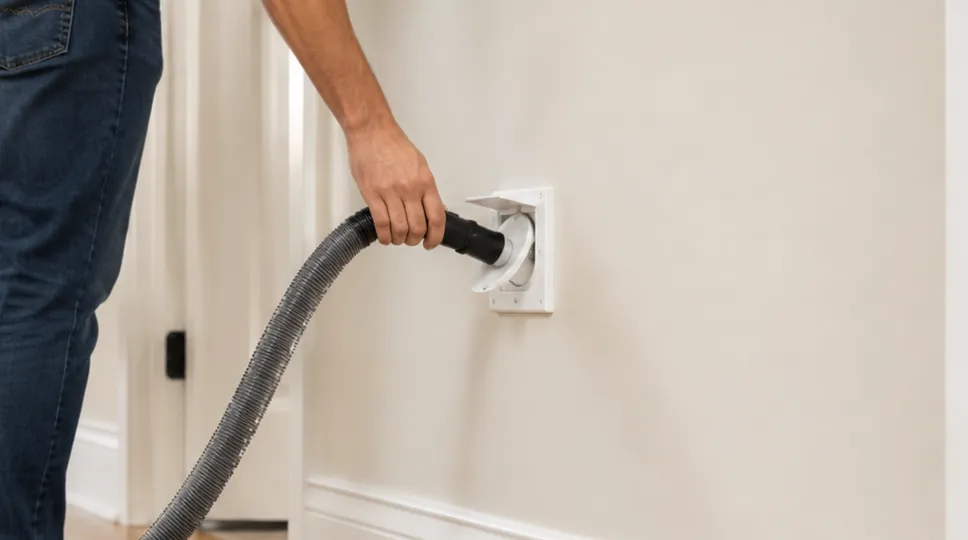
If you’ve moved into an older home, you may have noticed round metal inlets near the baseboards. You’ve probably wondered what is central vacuuming and why your house seems to have plumbing for it. A central vacuum, sometimes called a built-in vacuum system, isn’t an appliance you plug in and push from room to room. Instead, it uses hidden pipe inside your walls that connects to a single power unit tucked away in the garage, basement, or utility room.
For a lot of homeowners, especially those who bought a resale property where the system predates them, that’s about as far as the understanding goes. The inlets exist, the hose fits somewhere, and beyond that it’s a mystery — until suction starts to fade and there’s no obvious filter to check.
Quick Answer: Central vacuuming uses wall inlets, hidden pipe, and a central power unit. The system pulls dirt and dust out of your living space and deposits it in a canister elsewhere in the house. It’s more powerful than a portable vacuum and much quieter in the room you’re cleaning. However, the pipe network still needs periodic professional cleaning—not just filter or bag changes—to keep suction strong.
You Bought the House — Now What Are These Wall Inlets For?
This is usually where the question starts. A new homeowner walks their resale property, notices two or three round metal plates near the floor in the hallway, living room, and basement, and has no idea what they’re looking at. Nobody handed over a manual because someone installed the system a decade or two before they bought the place.
Those plates are inlet valves—the only visible part of a central vacuum cleaner. Behind each one, PVC pipe runs through the wall cavities and connects to a central power unit. Installers usually place that unit in the garage or a basement utility area. Plug a hose into any inlet, and the suction motor switches on. It pulls debris through the pipe network into a canister instead of a bag you’re dragging from room to room.
What Is Central Vacuuming, Mechanically? The Pipe Network and Power Unit, Explained
The system only has three real components: inlet valves, the pipe network connecting them, and the power unit itself. When the hose goes into an inlet, it completes a low-voltage circuit that tells the power unit to start pulling air. That airflow is what actually moves the dirt — not the hose attachment, which just directs where you’re cleaning.
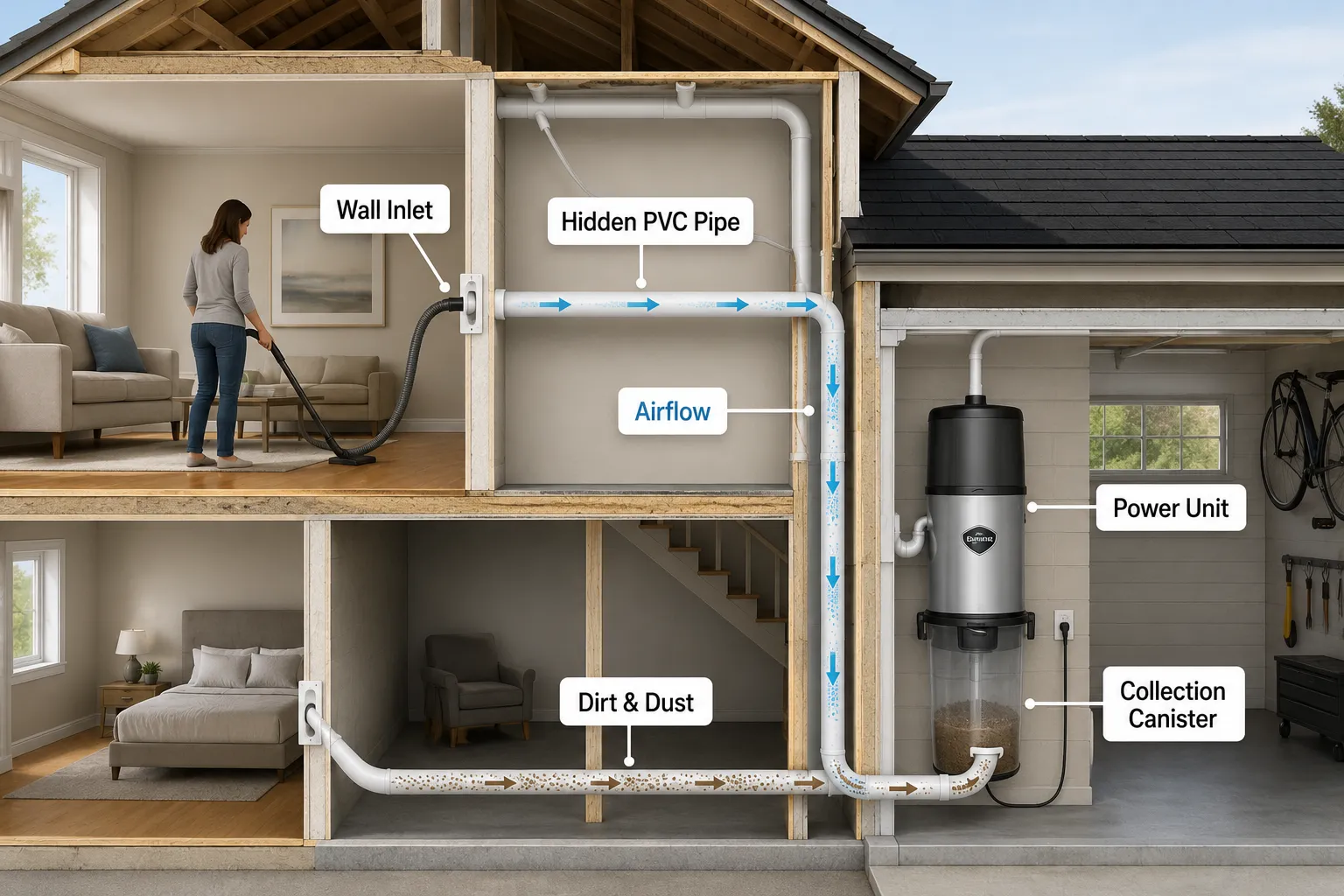
Where this tends to go wrong isn’t usually the motor. It’s the joints. Installers assembled many older pipe runs with a mix of glued and friction-fit sections. Over 15–20 years, some of those joints can loosen slightly, especially where the pipe passes through exterior walls exposed to Saskatchewan’s temperature swings. A loose joint usually won’t stop the vacuum from running. Instead, it quietly leaks suction along the way, so the inlet farthest from the power unit often feels noticeably weaker than the one closest to it.
Why a Central Vac Can Have a Fully Functional Motor and Still Feel Weak
A working motor and a working system are two different things, and this is the part that trips up almost everyone with an older built-in vacuum. The motor spins up fine, you can hear it, and yet the hose barely picks up anything at the far end of the house.
One thing we see constantly on resale homes in Yorkton and Saskatoon is a power unit that nobody has opened since installers put it in. Over time, fine dust and debris can collect inside the pipe network instead of only in the canister. That buildup reduces the pipe’s effective diameter and restricts airflow. The result is similar to what happens when restricted airflow forces any HVAC system to work harder, whether it’s a furnace duct or a central vac pipe network. The motor isn’t the problem; the pathway is.
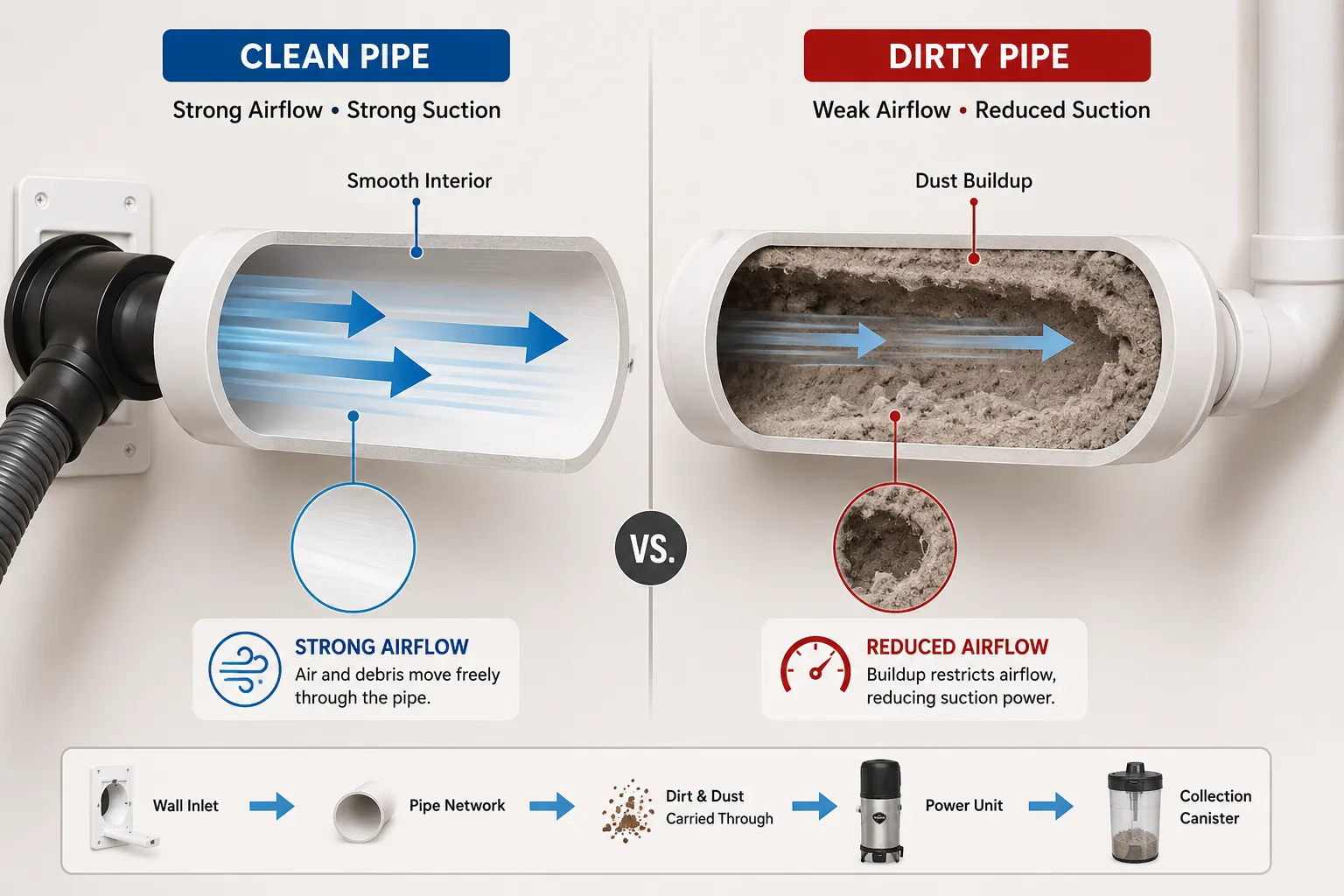
If suction has been fading, don’t assume the whole system has failed. The issue could be as simple as a clogged pipe network rather than the motor itself. Get in touch for a free quote, and we’ll explain exactly what’s causing the problem.
Swapping a Filter Isn’t the Same as Cleaning the System
There’s a common assumption that a central vacuum is maintenance-free because there’s no bag to empty every week. That’s true for day-to-day use, but it leads to a misconception: that changing the filter or emptying the canister once in a while is the same as cleaning the system. It isn’t.
Our technicians often meet homeowners who have replaced the filter two or three times. They still can’t figure out why suction hasn’t improved. The filter only handles debris that reaches the canister. It can’t remove residue inside the pipe network or buildup around the motor housing. Clearing the actual pipe network is a different job, much like duct cleaning serves a different system in the house. Our central vac cleaning service focuses on clearing that pipe network, not just servicing the canister.
What Changes When the System Predates You by 20 Years
When builders install a central vacuum in a new home, you know the pipe network starts out clean. A resale home is different, even if the parts look identical. You’re inheriting years of use, especially in older homes across Saskatchewan. In most cases, you have no record of when someone last cleaned the pipe network—or whether anyone cleaned it at all.
That’s not a reason to assume the worst. Plenty of older systems run well for years with very little attention. However, if you’ve just bought a resale home and the inlets work but suction feels weak, have the system inspected first. Cleaning an existing pipe network usually costs much less than replacing the entire central vacuum system.
If you’re already noticing specific symptoms — a burning smell, the motor cycling on and off, or one inlet that’s dead while others work — that’s covered in more detail in our post on common central vacuum problems.
Frequently Asked Questions
How Do I Know if Central Vacuuming Is Still Working Properly After Buying a Resale Home?
Plug the hose into each inlet valve one at a time. Check whether the motor starts and whether suction feels consistent throughout the house. A dead inlet, a motor that won’t start, or much weaker suction at the farthest inlet are the main signs that the system needs attention.
Does Central Vacuuming Use a Bag, and How Often Does It Need Emptying?
Most central vacuum systems use either a bag or a bagless canister at the power unit. Cyclonic canisters typically need emptying two to three times a year, while bagged systems usually need attention about every six months. The exact schedule depends on household size and usage. Even so, emptying the canister doesn’t clean the pipe network.
If my furnace ducts were just cleaned, does that cover the central vacuum too?
No — the two run through completely separate pipe networks with no shared points, so cleaning one has no effect on the other. It’s a common assumption on resale homes where both systems are old and the owner figures “it’s all just pipes in the walls.” Schedule each system independently because cleaning one doesn’t affect the other.
How often should the actual pipe network be cleaned, not just the canister?
There’s no fixed calendar rule — it depends on age of the install, household dust levels, and how the system’s been used. As a general guide, if you can’t recall the pipe network ever being cleaned and the system is more than a few years old, it’s worth having it assessed rather than waiting for suction to noticeably drop first.
Dun-Rite Vac has served Saskatchewan homeowners since 1998 as a family-run, NADCA-certified company. We’ve completed more than 50,000 jobs across Saskatoon, Yorkton, Regina, and Weyburn. If your central vacuum’s history is a mystery, we’ll inspect it and tell you honestly whether it needs cleaning or no service at all. Request a Free Quote