
Cleaning your HRV filter is one of the few HVAC maintenance tasks that actually belongs on the homeowner’s to-do list — it’s straightforward, takes about fifteen minutes, and makes a real difference in how well the unit performs. But the filter is only one part of the system, and it’s worth understanding what you can handle yourself versus what genuinely requires a professional to do right.
Quick Answer: To clean an HRV filter, remove it from the unit, vacuum off loose debris, then rinse it gently with lukewarm water and let it dry completely before reinstalling — aim to do this every one to three months during the heating season. The HRV core (the heat-exchange element inside the unit) is a separate component that needs professional cleaning, typically every two to three years, and should not be confused with the filter.
How to Clean Your HRV Filter (Step by Step)
Most HRV units have filters located behind a small access panel, either on the unit itself or in the return-air grilles — check your unit’s manual if you’re not sure where yours are (many models have two). Here’s the process:
- Turn the unit off before opening any panels.
- Remove the filter. Most slide or clip out without tools. Note which direction it was facing.
- Vacuum first. Use a soft brush attachment to remove the bulk of the dust before wetting the filter — this keeps debris from clogging the mesh when you rinse.
- Rinse with lukewarm water. Hold the filter under a gentle stream — no pressure washers, no soaking in chemicals. The mesh is more fragile than it looks.
- Let it dry completely before reinstalling — a damp filter reinstalled in a running unit can promote mold growth inside the housing (U.S. EPA).
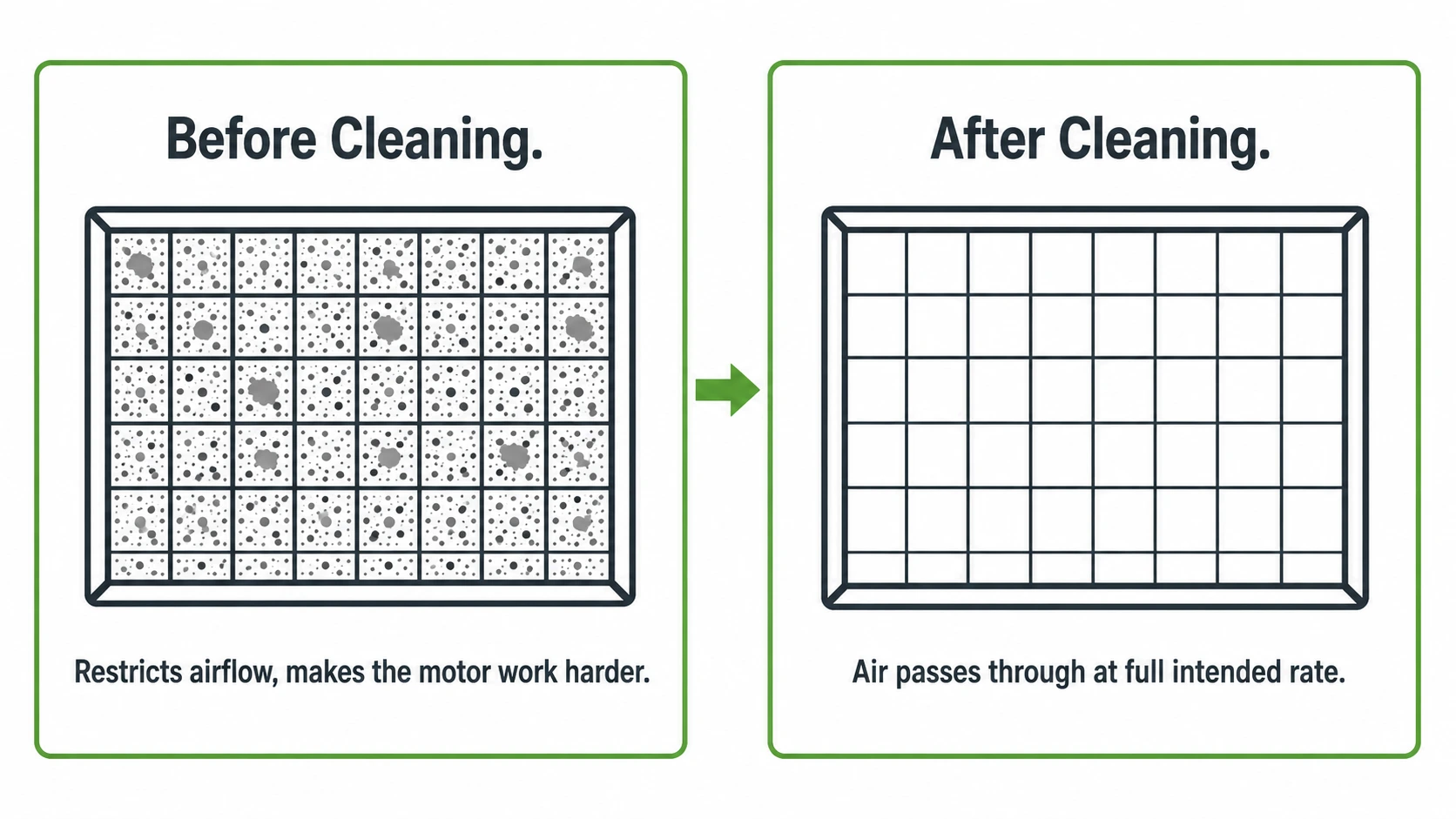
- Reinstall and run the unit. If airflow seems noticeably stronger than before the cleaning, that’s normal — it means the filter was genuinely restricting flow.
A clogged filter will look noticeably grayer and feel stiffer than a clean one, even before you get it under water — that visual difference alone is often enough to tell you it was overdue.
That’s the whole DIY task. It costs nothing, takes about fifteen minutes, and actually matters for the unit’s performance.
How Often the Filter Actually Needs Cleaning in a Saskatchewan Home
Natural Resources Canada recommends cleaning HRV filters every one to three months — but in practice, the right interval depends more on your home than on the calendar. A tight, newer build in town with no pets and no renovation work in the past year can probably go toward the three-month end. An older home, a house with dogs or cats, or a property that had any drywall or flooring work done recently will load the filters faster.
What we regularly find when a homeowner hasn’t touched the filters in two or more seasons is a mat of compacted dust, pet hair, and sometimes frost residue that no longer lets air pass through at anything close to the intended rate. At that point the unit is working harder to move less air, which shortens the motor’s life and defeats most of the reason you have an HRV in the first place.
Saskatchewan’s heating season is one of the longest in Canada — furnaces in Saskatoon, Yorkton, and Regina routinely run from October through April. That compressed cycle means filters load faster here than in milder climates. A check every six to eight weeks through the heating season is a reasonable habit, even if you’re not washing the filter every single time.
Filter vs. Core: Why the Distinction Matters
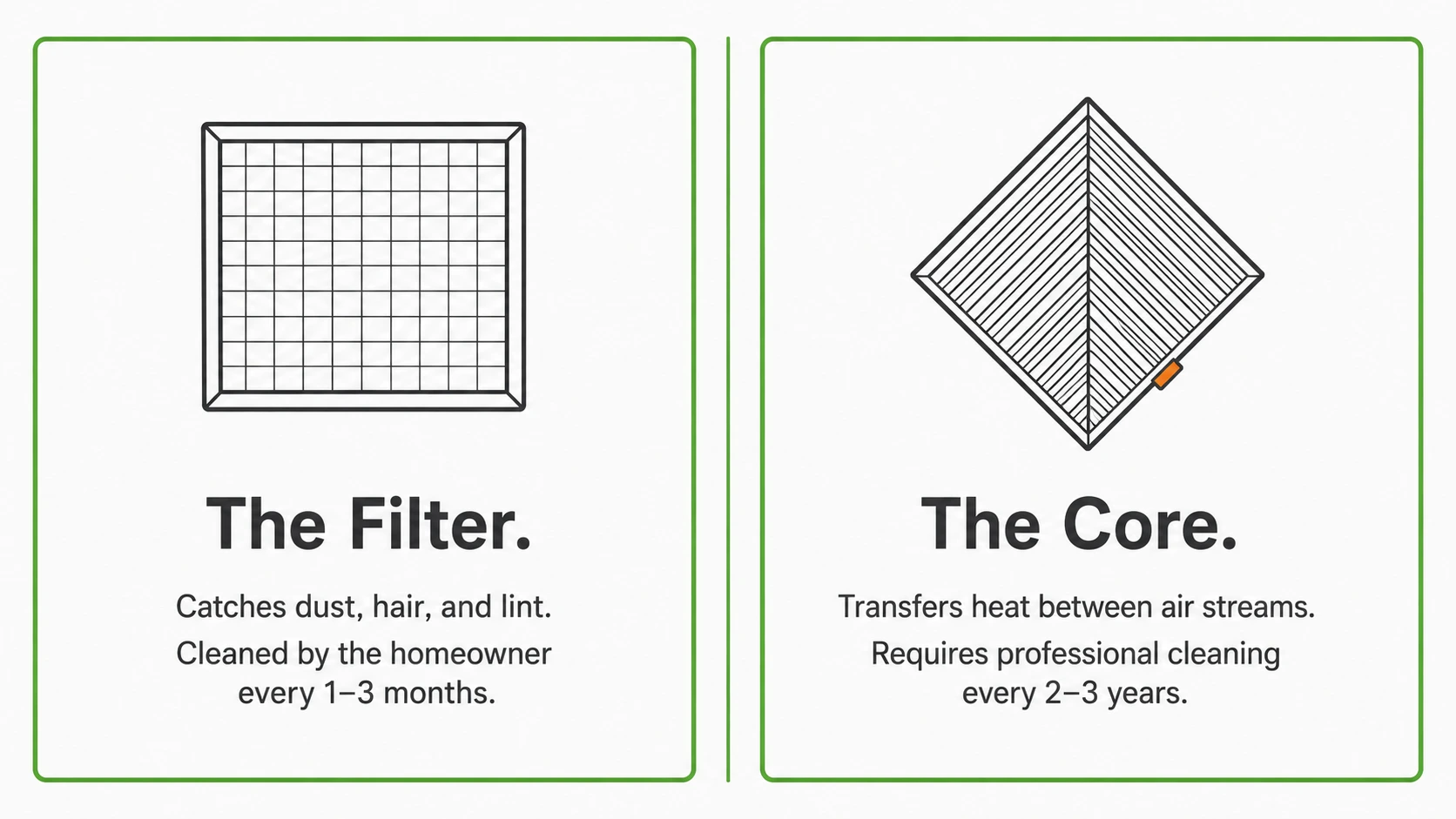
There’s a common assumption that cleaning the filter and cleaning the HRV are the same task — and that if you’re looking into how to clean an HRV core, it’s just a more thorough version of the same job. It isn’t. The filter and the core are separate components that fail differently, load differently, and require completely different approaches to clean properly.
The filter catches visible particles — dust, hair, lint — before they reach the heat-exchange core. It’s designed to be removed and cleaned by the homeowner. The core is the internal element where incoming cold air and outgoing warm air pass through adjacent channels to transfer heat without mixing. Over time, fine particulate bypasses or degrades past the filter and deposits on the core’s surface. You can’t see this from the outside, and rinsing the filter does nothing to address it.
A partially fouled core reduces heat-recovery efficiency, which is the primary energy benefit of having an HRV system. In a climate where the unit is recovering heat from exhaust air for months at a stretch, even a moderate efficiency drop adds up on a utility bill.
When the Filter Isn’t the Whole Problem
A freshly cleaned filter and still-sluggish airflow is a reliable sign that something else in the system needs attention. The two most common culprits: a fouled core, or buildup in the ductwork connecting the HRV to the rest of the ventilation system.
The ductwork connection is easy to overlook — HRV runs are short, so homeowners assume there isn’t enough length for meaningful buildup. There usually is, especially where the HRV ties directly into the central duct system.
If you’ve cleaned the filter and airflow hasn’t improved, or if the unit is running more frequently than it used to, that’s a reasonable point to bring in a professional rather than continuing to clean a filter that isn’t the source of the problem.
Not sure if your HRV just needs a filter rinse or something more?
Our technicians can assess the full system during a cleaning visit and tell you exactly what’s going on. Reach out for a quote — no obligation, and we’ll give you a straight answer either way.
What Professional HRV Core Cleaning Actually Covers
Cleaning the HRV core isn’t a DIY task — not because it’s mechanically complicated, but because doing it incorrectly can damage the core’s delicate exchange surfaces or leave moisture trapped inside the unit. Professional cleaning involves removing the core, cleaning it with methods appropriate to its construction, inspecting the housing and drain pan for any signs of mold or biological growth, and verifying that airflow is balanced properly after reassembly.
That cleaning happens at a workbench rather than inside the housing — pulling the core out lets a technician access every channel surface directly, rather than trying to reach into a wall-mounted unit.
On acreage properties especially, we often pull HRV cores that are coated in a combination of dust, construction debris from older homes, and the fine particulate that comes with burning wood as a supplementary heat source — none of that rinses off, and it doesn’t respond to the same approach you’d use on a city home with gas heat only.
Dun-Rite’s NADCA-certified, ASCS-credentialed technicians have completed over 50,000 jobs across Saskatchewan and Western Manitoba — including HRV systems in conditions that no manufacturer manual accounts for. The standard doesn’t change: balanced airflow, clean exchange surfaces, nothing left damp inside the housing. For the full picture of what’s included, see our air exchanger cleaning service page.
Most homes need professional core cleaning every few years alongside regular filter maintenance — exact frequency depends on usage, home type, and local conditions. CMHC notes that buildup inside an HRV lowers its ventilation and heat-recovery efficiency — a meaningful cost over a long Prairie heating season. If you’ve never had the core cleaned and your HRV has been running for more than three years, it’s worth booking.
Frequently Asked Questions
Can I use soap or cleaning products when rinsing the HRV filter?
Plain lukewarm water is sufficient for most filter cleanings. If the filter is heavily soiled, a very small amount of mild dish soap is acceptable — rinse thoroughly afterward. Avoid anything with strong solvents or citrus-based degreasers, which can degrade the filter mesh over time.
My HRV has two filters — do I need to clean both the same way?
Yes, though they may accumulate differently. One filter handles the incoming fresh-air stream, the other handles the exhaust stream leaving the house. In homes with pets or older carpeting, the exhaust-side filter tends to load faster. Both should be cleaned on the same schedule — letting one slide because it “looked okay” last time is how filters get missed for a full season.
Is there a risk of mold inside an HRV system?
There can be, particularly in the drain pan that collects condensate. Prairie winters produce significant humidity swings, and if the drain pan isn’t clearing properly or the unit runs for years without a core cleaning, biological growth is possible. It’s one of the things a technician checks during a professional cleaning visit — if there’s any sign of mold or bacterial buildup, HVAC sanitization addresses it directly rather than just cleaning around it.
How do I know if my HRV core needs professional cleaning versus just the filter?
The clearest signal is that cleaning the filter doesn’t restore normal airflow. If the unit sounds like it’s working harder than it used to, if rooms that used to feel well-ventilated now feel stale, or if it’s been three or more years without a professional cleaning regardless of filter maintenance, those are reliable reasons to book a service call rather than waiting for a more obvious symptom. For a broader look at what regular HRV upkeep should include beyond filter cleaning, our post on HRV system maintenance covers the full picture.
Can I clean my HRV core myself?
Technically you can remove the core on most units — but cleaning it correctly is where DIY tends to go wrong. The core’s exchange surfaces are fragile, and using the wrong method or leaving moisture trapped inside can cause more damage than a dirty core would have. A fouled core also rarely looks bad from the outside, so it’s easy to assume you’ve done a thorough job when you haven’t. The consequences — reduced efficiency, moisture problems, potential mold — can take months to surface.
Ready to get your HRV running the way it should?
If regular filter cleaning isn’t cutting it, our NADCA-certified team can clean the core, inspect the housing, and make sure the system is balanced and performing properly — backed by our 100% Satisfaction Guarantee.