
If you’ve got an air exchanger (HRV or ERV) running in your Saskatchewan home, the filter and core schedule that works in Ontario or BC simply doesn’t apply here. Our winters keep these units running near-continuously for months at a stretch, and that changes how often you should clean your air exchanger compared to a milder climate.
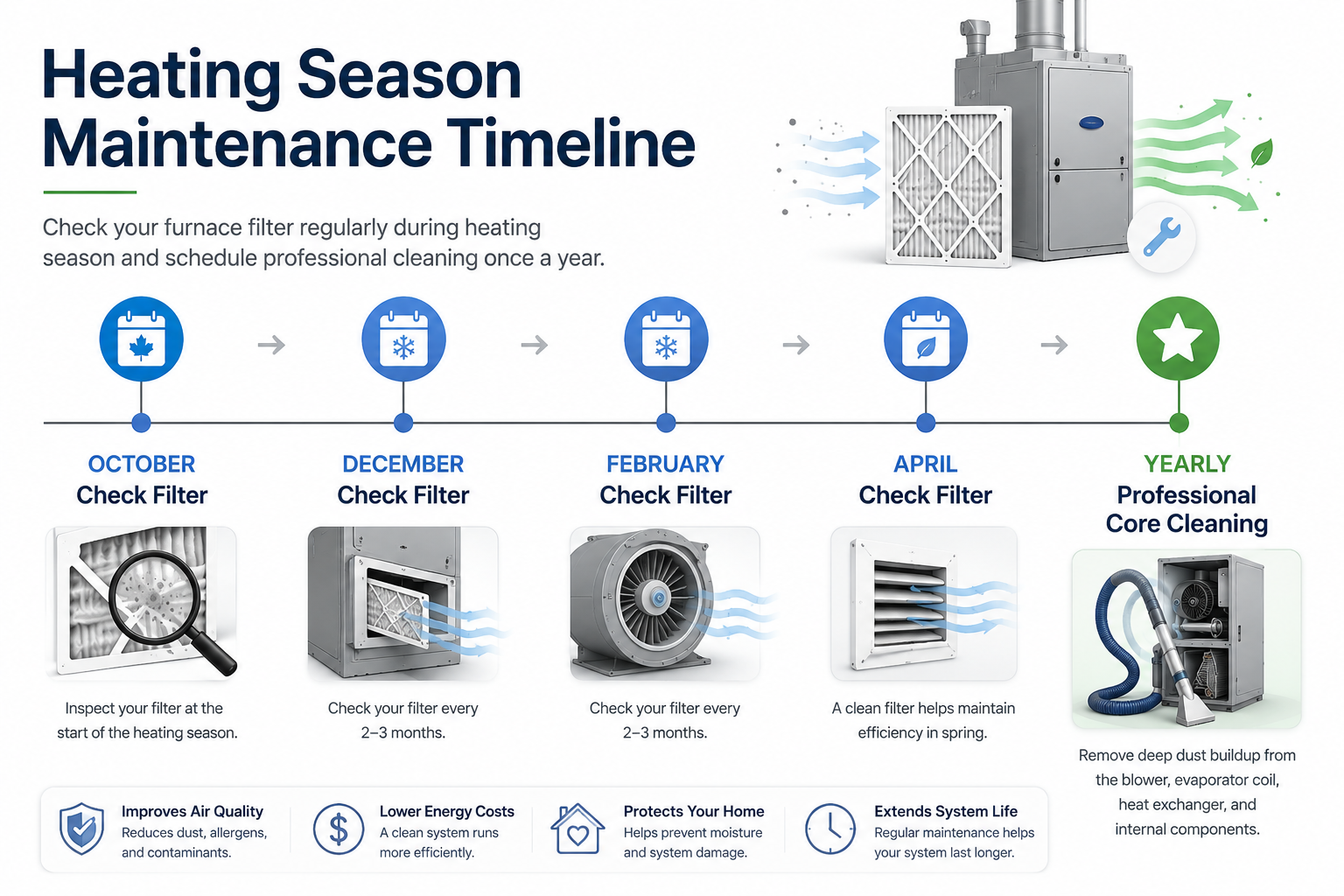
Quick Answer: In most Saskatchewan and Western Manitoba homes, check and vacuum or rinse HRV/ERV filters every 2-3 months during heating season (roughly October through April). Schedule a full professional core and duct cleaning once a year. Acreage properties, pet households, and homes running the unit continuously on low often need filter checks closer to monthly.
Why a Five-Month Heating Season Changes the Math
Most manufacturer manuals quote a generic filter-check interval because they’re written for a national market, not a Prairie winter. Even Natural Resources Canada’s official HRV maintenance schedule uses a national baseline. An HRV in Yorkton or Saskatoon moves air through its core essentially around the clock from late October through March. That means the filter does five or six months of continuous work. A milder-climate home spreads that same workload across a much shorter season.
Our technicians regularly find visibly grey or matted filters in Yorkton and Saskatoon homes built or retrofitted over the last 15-20 years. It’s rarely a case of carelessness. Most homeowners simply aren’t told that the rule of thumb changes once an HRV runs through a Prairie winter. The manufacturer’s “every 3-4 months” guidance assumes lighter seasonal use. Here, that same interval can leave the filter overloaded for weeks.
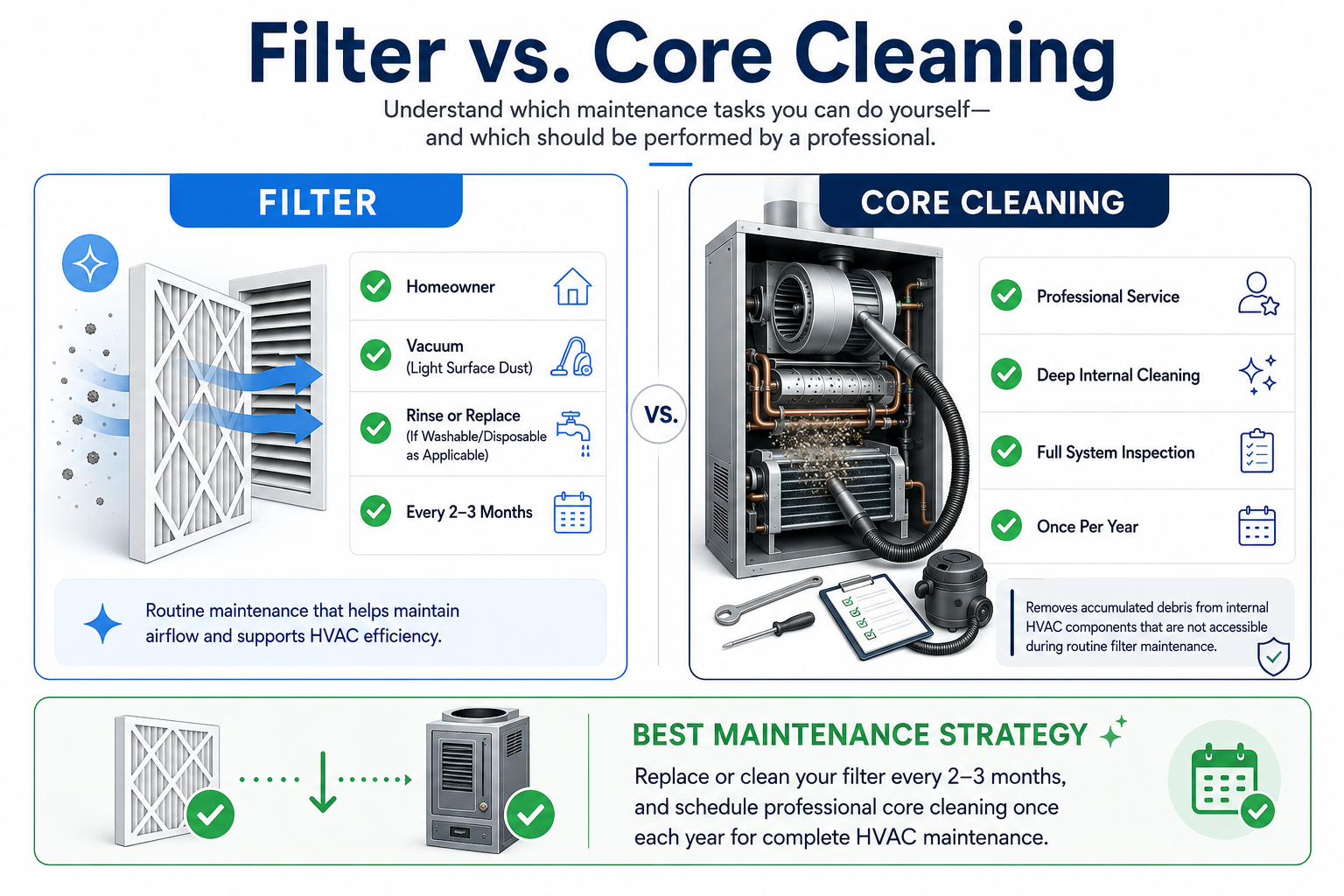
Filter Checks vs. Core Cleaning — Two Different Clocks
Homeowners often treat “cleaning the air exchanger” as one task, but it’s really two separate jobs running on different timelines, and conflating them is where most maintenance gaps start.
The filter is the part you can handle yourself. Vacuum or rinse it every 2-3 months during heating season to prevent surface dust and pet hair from restricting airflow. The core is different. Moisture, fine dust, and sometimes mould can build up inside areas that homeowners can’t easily reach. That’s the part that needs a full professional air exchanger cleaning about once a year, regardless of how often you clean the filter.
If you want the step-by-step on the filter side, our guide on cleaning your HRV filter walks through it in detail.
What Happens When the Core Gets Overlooked
A neglected filter is an inconvenience. A neglected core is where things actually go wrong. When the core accumulates enough buildup, the unit’s ability to transfer heat between incoming and outgoing air drops. In a cold-climate-sealed home, that shows up one of two ways. Either the air exchanger starts icing up and tripping into defrost mode more often — condensation inside a neglected core can freeze and block the exhaust airflow entirely in colder conditions — or the homeowner quietly disables it because it “doesn’t seem to be doing anything,” which then lets indoor humidity and stale air build up in a home that’s too tightly sealed to clear itself naturally.
Either outcome defeats the purpose of having installed the unit in the first place, and in the worst cases, a core that’s gone too long without attention can freeze solid mid-winter, leaving a homeowner with no fresh-air exchange until it’s serviced.
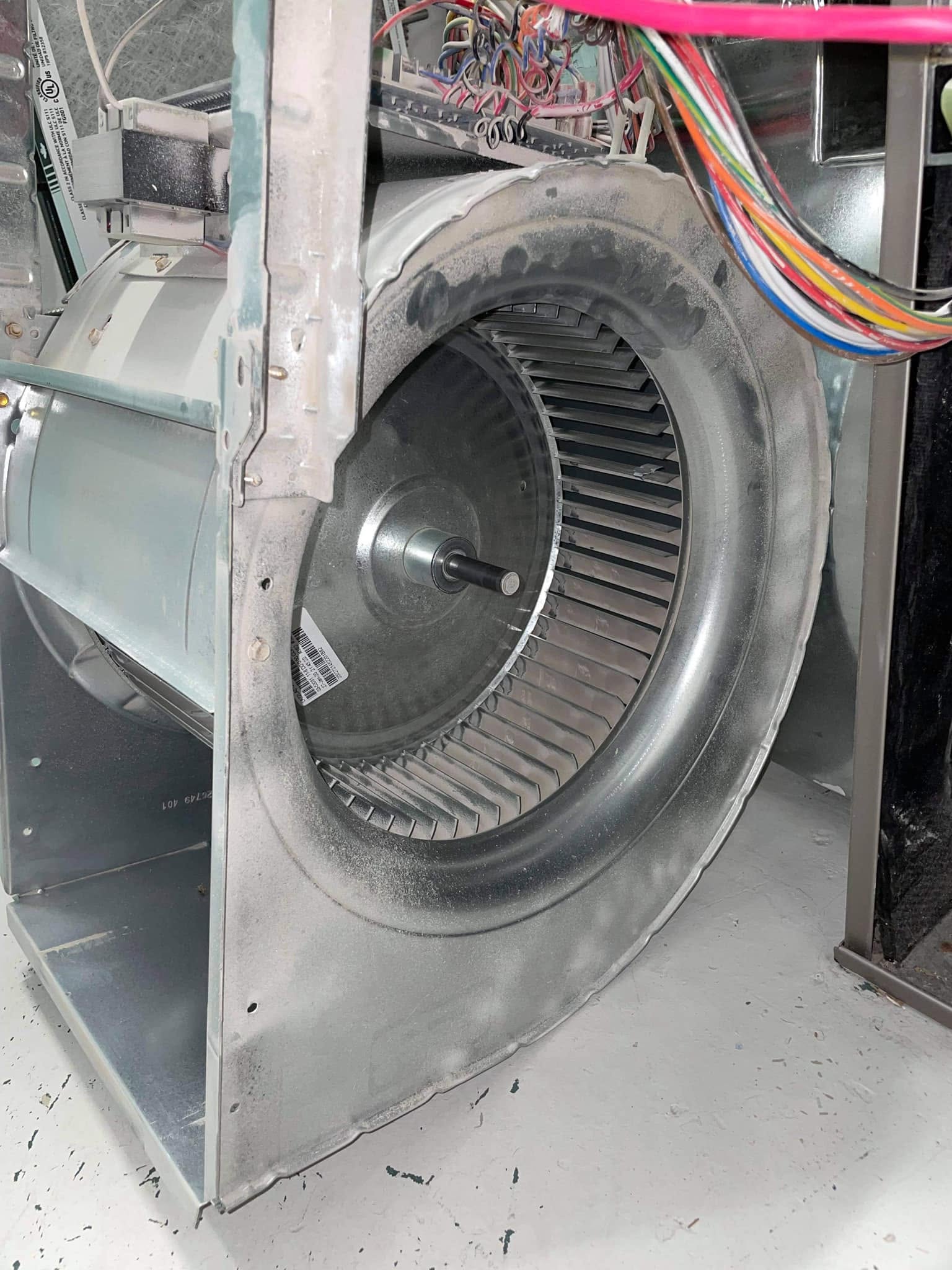
If your air exchanger has been running all winter without a core check, or you’ve noticed icing, reduced airflow, or a musty smell from the vents, it’s worth getting ahead of it before the next cold snap. Reach out for a free quote and we’ll take a look.
Why Your Property Type Moves the Schedule
The “every 2-3 months for filters, yearly for the core” guideline is a starting point, not a fixed rule — and the homes where we end up adjusting it most are acreage and rural properties.
We often see the same pattern on acreage properties west of Yorkton. Homeowners run their air exchanger on the lowest continuous setting to save on heating costs. It feels efficient, but it actually concentrates moisture and dust in the core faster than a properly balanced higher setting. Add a well-water furnace setup, a dusty rural road, or a couple of dogs in the house. In those situations, monthly filter checks usually make more sense than quarterly ones. Multi-unit and older sealed-tight homes can fall anywhere within that range depending on occupancy and pets. The right schedule is genuinely property-specific.
Should You Even Be Running It on Low to Save Money?
It’s a fair question, and the honest answer is that it depends on what you’re optimizing for. Running an HRV on its lowest continuous setting reduces the energy needed to condition incoming air. However, it also slows airflow through the core. That gives moisture and fine particles more time to settle instead of passing through and exhausting outside.
For most Saskatchewan homes, a mid-range continuous setting with periodic boost during cooking or showering strikes a better balance — adequate fresh-air exchange without running the unit so low that the core becomes a moisture trap. If you’re unsure what setting your unit is on or whether it’s appropriate for your home’s size and occupancy, that’s a quick thing to check during a routine cleaning visit rather than guessing.
FAQ
Can I just leave my air exchanger filter in longer if it still looks okay?
Visual inspection only tells part of the story — fine dust and lint can reduce airflow before the filter looks obviously dirty. Sticking to the 2-3 month heating-season check is more reliable than judging by eye alone, especially since a slow-loading filter rarely shows dramatic visual signs until it’s well overdue.
Does an ERV need cleaning as often as an HRV?
Both unit types follow the same general filter and core schedule, since the difference between them is in how they handle humidity transfer, not in how dust and debris accumulate. The Prairie heating-season runtime factor applies equally to either.
What’s the actual sign that my core needs cleaning, not just the filter?
Reduced airflow at the vents even after a fresh filter, a musty smell when the unit kicks on, or the unit icing up and going into defrost more frequently than it used to are the clearest signs the core — not just the filter — needs attention.
Is a yearly professional cleaning enough, or should it be more often for an older HRV unit?
For most households, once a year is the right interval for the core. Older units, acreage properties, or homes with heavier dust/pet load are the cases where we’d suggest checking in sooner rather than waiting the full year — it’s worth flagging your specific situation when you book so we can advise accordingly.
You Might Also Find This Helpful
Not sure where your air exchanger stands?
We’ve cleaned and serviced air exchangers across Saskatoon, Yorkton, Regina, and Weyburn for over 27 years as a NADCA-certified, ASCS-trained team, and we stand behind every job with our 100% Satisfaction Guarantee. Get in touch for a free quote and we’ll tell you straight whether your unit needs attention now or can wait.